THE GREAT
WHITE NORTH

Canada is the second largest country in the world in land area, after Russia. It has the longest border with water (coastline) of any country in the world. It is next to the Pacific, Arctic, and Atlantic Oceans. It is the only country in the world to be next to three oceans at once. It has six time zones.
Canada is made up of ten provinces and three territories. Most large cities in Canada are in the southern part of the country, including Toronto, Vancouver, and Montreal. There are very few people living in the northern part of Canada.
Canada extends from the west coast, across the prairies and central Canada, to the Atlantic provinces. In the north there are three territories, stretching between Alaska and Greenland: the Yukon in the west, then the Northwest Territories, then Nunavut. Four of the five Great Lakes (Superior, Huron, Erie, and Ontario) are shared between Canada and the United States (Lake Michigan is in the USA), and they make up 16% of the Earth's fresh water. The Saint Lawrence Seaway joins the Great Lakes to the Atlantic Ocean, allowing ocean going vessels to travel as far inland as Thunder Bay in Ontario, Canada.
Canada shares land and sea borders with the USA (the lower 48 states and Alaska), Denmark (Greenland), and France (St. Pierre and Miquelon — a small group of islands off the southern coast off the island of Newfoundland).
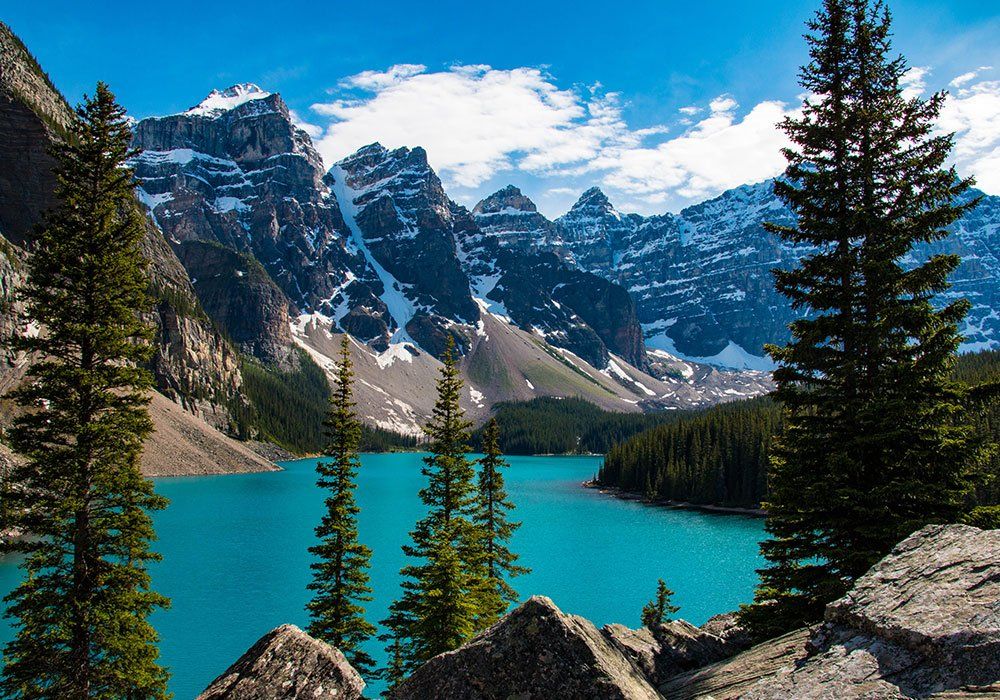
The geography of Canada is very different from place to place, from high alpine areas in the west, flat grasslands and prairies in the centre, and ancient shield rocks in the east. Canada contains some of the very last untouched boreal forest in the world. Canada's vast swaths of wilderness include lake-filled Banff National Park in the Rocky Mountains. It's also home to Niagara Falls, a famous group of massive waterfalls.
Official Language: English and French
Capital:
Ottawa
Government: Constitutional Monarchy
Head of State: Prime Minister Justin Trudeau
Religion: Christianity
Currency: Canadian Dollar $
Internet-TLD: .ca
Telephone:
+1
Dietary Requirements
In a multi-ethnic, restaurant-heavy country like Canada, it can sometimes be a bit of a challenge to define what exactly counts as “Canadian food.” In general, most Canadians eat a largely “western” diet broadly similar to the diet of Americans and Europeans, with a heavy focus on processed grain and dairy products, farm-grown beef and chicken, certain cooked or fresh fruits and vegetables, and questionable amounts of salt and sugar.
The favorite foods of Canadians vary slightly from region to region, and are strongly influenced by their family heritage, especially in relation to holiday celebrations. Along the Atlantic coast, seafood and dishes derived from English traditions (except in Quebec) are common. In Quebec, favorite foods come from the area's French heritage. Throughout Canada, maple syrup and maple products are popular, reflecting the significance of the maple tree, whose leaf adorns the flag of Canada. Many families enjoy a visit in early spring to a maple sugar "shack," the special rustic building where sap from maple trees is boiled in a large open pan to make maple syrup.
Few Canadian dishes are as world-renowned as the glorious creation known as poutine. Crispy fries, squeaky cheese curds and rich gravy all combine to create the meal of dreams, and this French Canadian food is so popular that it can now be found all around the world. The classic version is great on its own, but toppings like pulled pork, bacon and smoked meat really knock it out of the park.
Some other traditional or well known Canadian foods include: CAESAR COCKTAILS, BEAVERTAILS, BUTTER TARTS, NANAIMO BARS, KETCHUP CHIPS AND ALL DRESSED CHIPS, MONTREAL BAGELS.
Ecology
Canada occupies the top half of the North American continent, where it borders the United States - Canada’s only neighbouring nation - to its south (and north-east, via the isolated state of Alaska).
The Canadian geography unfolds in two directions: west to east and north to south. The more north you go, the colder, rockier, snowier, and overall less suitable for living the country gets, which explains why few people go through the hassle.
From west to east unfolds the more liveable portion, and a vast array of geographic diversity encompassing everything from lush green valleys to dry, sandy deserts.
Climate
Canada's climate is as diverse as its landscape. Generally, Canadians enjoy four very distinct seasons, particularly in the more populated regions along the US border. Daytime summer temperatures can rise to 35°C and higher, while lows of -25°C are not uncommon in winter. More moderate temperatures are the norm in spring and fall.
Summers can be hot and dry on the prairies, humid in central Canada, and milder on the coasts. Spring is generally pleasant across the country. Autumns are often crisp and cool.
Winters are generally cold with periods of snow. On the west coast winters are mild and wet, in cities such as Vancouver and Victoria.
Visa
You'll need to get an electronic travel authorisation (eTA) before you travel to Canada by air, whether your visit is for tourism, business, study, work, transit or any other purpose.
The Australian Government can't provide assistance with visa issues of Australians seeking to enter Canada. This includes those with valid Canadian visas who are refused permission to enter or are required to depart.
Penalties may apply if you overstay.
Make sure your passport is valid for at least six months from the date you intend to return to Australia.
CANADA
AVAILABLE TOURS
Note: A 25% per person non refundable deposit is required at the time of booking.